Tuesday, 27 October 2015

New species spawning for me!

So, it's been really long time since I had a real fish-update on my blog. Simply due to being busy looking for a new job, building a playhouse for my son and refitting the fishroom (which is still not finished!).

Recently I redistributed some Corydoras in my rack with 30 litre tanks. After being occupied by Poecilia wingei of various forms for a couple of years it was now time to get back in the Cory-game!

One of the species I wanted to try was my C129. I have kept them on 2 occasions - the fist group I had for a few years but they refused to spawn no matter what I tried so eventually they were sold off during a clean-out.

Two years ago I bought some again. They came as Corydoras sp. "Victoria" via Glaser, and although I had hoped for CW30 it turned out to be C129 as expected. Still a nice species that I hadn't succeeded with so why not try it again? It has been two years and only now did I actually do something about it!
After 4 days there was eggs this morning, spread evenly on the glass in 1-2-3s all over the tank. Now time will tell if the eggs will hatch and fry can be raised.

Grey Corydoras with black spots - still nice!

Looking promising...

The tank. The big chestnut-leaf was added yesterday. Trigger?


The tankmates; Caridina mariae "Supertiger".


Monday, 12 October 2015

Missing pictures

I am moving some pictures around between folders. This might give some missing pictures here and there. I hope to be over the problem soon!


Sunday, 4 October 2015

Garden-season ending and shrimp-disease!

Previously I showed a few bits from my outdoors-project here and here. It was the worst season ever, looking at the amount of breeding. Actually only Tanichthys albonubes reproduced themselves, even those only in small numbers.

But the fish and shrimp that I took in over the last week really showed some great colours and they have grown well over the summer. Here's a few:

Nice and very red Neocaridina davidi!

Probably descendant from Carbon Blue Rili. I had some leftovers from a colony that were not selected strictly and several varieties had popped up.

Corydoras plaeatus "Uruguay". Juveniles came out, almost adult fish came in!

 Aphanius danfordi "Soysalli".

The fishroom re-build is coming along in steps. The racks are running and I'm down to 39 tanks. Instead of the 54-litres, I set up some 16 and 70 litres. More pictures will follow. I have also bought some new LED-lights that need to be assembled. A project for the winther!


The worst part of an operation like this is the potential losses of stock while it goes on. The ones that took the biggest strike was my Caridina mariae "Red Tiger". They caught what I suppose was a bactierial infection of some kind. I was able to stop the deaths with JBL Furanol 2 (the only remedy I had in stock) as Cattappa leaves, Alder cones etc. didn't seem to help. As soon as I carried out a waterchange, the deaths would start again and evetually all the shrimps died. Snails and fish were totally unaffected. I was told Baytril Vet. would probably help, but I was not able to find a veterinarian to deliver.
I have restocked from a couple of German suppliers, among others Uwe Zeitler, who delivered perfectly packed specimens.

From this...

...to this...


...and ending with this...


Monday, 7 September 2015

Collecting! ...food and decor for fish and shrimps!

I have always enjoyed collecting my own supplements for the tanks and tubs. 

Over the summer I have collected a large amount of Asellus, Daphnia and Lumbriculus sp. from a small pond at my parents' place. The pond is around 30x30 metres with overhanging Alder-trees and a thick layer of branches and leaves over a clay substrate. The water is only 50 cm. at the deepest place. No fish are present.

The pond.

Easy to spot in the margins!


In the warmer months big clumps of Lumbriculus can be spotted along the edges and collected with a small net. Of course a lot of leaves, mud and small leeches etc. is collected along with the worms and to get the worms "purified", I use this simple method:

1: Pour the mud, leaves etc. through a mesh box for pond plants or something similar. Put the box into a tub with fresh, oxygen-rich water.


2: The worms crawl out and you can easily collect them with a pipette!


One of the places I collected plants this year was  a small pond hidden in some trees in the middle of a suburban area in my town. Big bushes of Callithiche sp. (Starworts) and Fontinalis sp. (Water moss) ready to be taken home and de-leeched. I don't mind Asellus and other small critters but big leeches I would rahter be without in my tubs and tanks.
Apart from the mentioned, there's almost no limit to what plants you can take home and try. Just avoid the red-listed ones!
Nice pond!

The moss.

Lemna trisulca: nice duckweed!


I have also collected some nettles for the shrimp to eat. Again it is my parent's place that has an abundance if these plants.
I use them "raw" so to speak; just dried for a day and then I feed them. Stem and leaves. The whole lot! I am shure they are collected in a pesticide-free place and as a side-bonus the Poecilia wingei love the small spiders and other critters that goes in the tank along with the nettles.

Drying nettles.

A trip in the forest revealed some nice wood-peices to carry home...just make shure it's safe types like Oak, Beech etc.


Saturday, 8 August 2015

Garden shrimp!

It's been a looong time since I've made an update to the blog. Vacation, rebuilding the fishroom etc. took all the available time.

In april I put some Neocaridina davidi in some tubs in the garden. They survived a light frost and have been crawling around without much happening. It has been quite cold in Denmark and only recently have we experienced stable, warmer weather with most days around 20C or warmer. 

I decided to have a look in the tubs yesterday...

N. davidi "Yellow Fire Neon" looked good, but no berried females. Some of them had turned green(ish). Will be exciting to follow that!

N. davidi "Topaz blue" was another story; lots of big, berried females! Some went inside the fishroom, but most stayed in the tub.

Big female carrying loads!

In a container for photos...

The habitat.

Enjoying summer.

The tubs are 60-90 litres filled with tapwater. Of course rain will slowly thin it up, but with N. davidi it's not a problem; they are hardy animals.

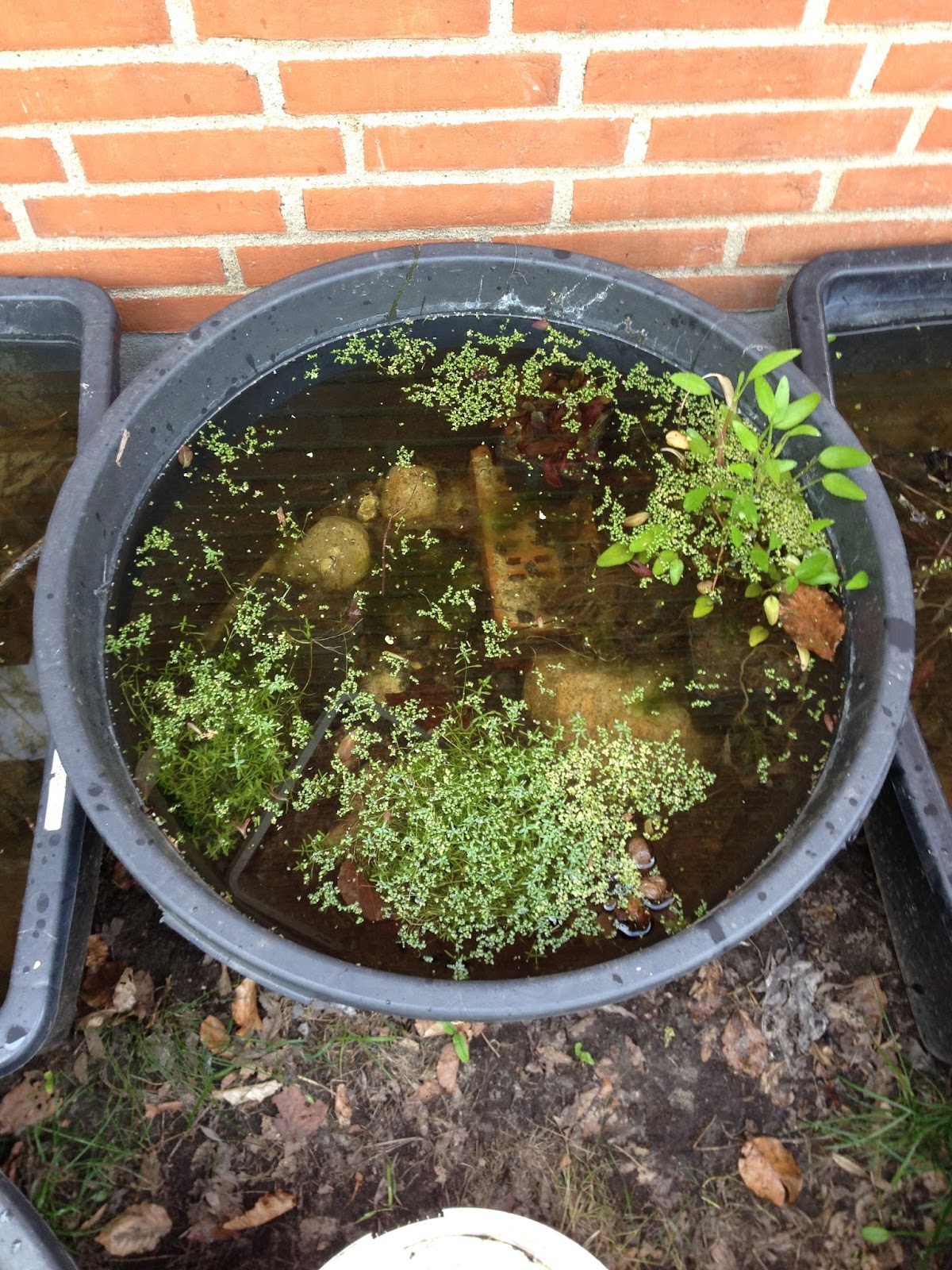
The soil is just dug up from the garden and my son has thrown some sand in there. An old brick and some twigs we found on the way home from daycare is also enjoyed by the shrimp for grazing. The plants are from a pond nearby.

I was intending to put more shrimp outside, especially Caridinas, but time would not allow it this year. I hope to do it next year!

Rebuilding the fishroom!

So, time was available for something I wanted to do for a long time; rebuild my fishroom!

Painting the racks, cutting back a few tanks and set up some different ones. It will mean a considerable change in stock, but it is welcomed. I need to "clean out" so to speak!

Painting....

Scrubbing the tanks.

Getting there!

 Need lights!


Monday, 22 June 2015

The great outdoors!


Keeping your aquarium fishes outside in the garden during the summer months is great! A lot of species really benefit from this with better health, better colours and so on.
I have done it myself in varying degree for some years. This year is no exception, although the project is not as big as I initially intended because I need time for other things too.

So, sometime mid-march, me and my son started setting up the tubs from last year:


It does not look like much, but once settled and the green leaves start to spread it gets quite nice:


The last pictured tub is planted with some Callitriche sp. and Fontinalis sp. found in a local pond.
It's a great way to find various plants and save money on the expensive ones at the garden centre!

The most problematic is to get the plants to stay where you put them when having this little guy around:


Placing the tubs is not always easy. I would like for mine to get more direct sunlight, but that is not possible due to different reasons. A place that gets a good amount of sun midday has worked well for me in the past, but is not possible at this time.

Fish-wise there is loads of choices you can make. There is a lot of readily available fish that do well outside. Common Xiphophorus from the local petshop, Tanichthys albonubes, Danio margaritatus etc.
Living in Denmark I look for fish that does well between 12C. and 25C. Soem that can go as low as 0-2C. expands the season a lot. The really hardcore enthusiasts have their fish fishes in insulated garden sheds during the winther to keep the just above freezing.

Danio margaritatus is a good garden fish in temperate climate.

You can also choose to get more "special" fishes like wildtype Xiphophorus. I have kept X. milleri outside for several years with excellent results. Also X. xiphidium does a good job on the tubs. For larger tubs/ponds, larger Xiphophorus, Jenynsia and Goodeid species is a good choice.

Xiphophorus milleri.

Xiphophorus xiphidium.

A classic; Xiphophorus variatus, wild form from Rio Nautla.

If it is warm enough fish like Poecilia wingei and reticulata are good fish for small tubs too. Another small livebearer that a favourite of mine is Heterandria formosa. If kept in a good tub, they can multiply really well during the season.

Looking in another direction, a lot of killifishes from Aphanius, Cyprinodon, Oryzias etc. can be kept outside. Although not something I have done a lot, I have kept a few Aphanius outside with varying luck. This year I am keeping Aphanius danfordi:

Aphanius danfordi "Soysalli" female.

Male.

Their tub has gotten a load of chalk to keep the watervalues at the hard end.

I have not looked for eggs yet, but will probably do so soon. From last year I have a picture of an egg in the filamentous algae:


More updates on my outdoor project and fish will follow over the summer. There is more to tell. I am trying some shrimps outside as well. Also, my tubs are in a more shaded area than I would like them to be so time will tell what works and what doesn't.